 Knowledge hub
 Articles

 10 min read
Every summer, organizations find out exactly who they can’t do without. And sadly, almost none of them write it down.
When offices run at half strength, the work that stalls tells you where the coverage was thinner than anyone thought. A deployment waits because the one person who knows how the client’s environment is configured is unreachable. An invoice goes out late because a single yet mandatory approval sits in an inbox nobody else can open.
In August, this is an inconvenience because vacation has a return date. But when the person resigns instead, that same gap means a quarter spent rebuilding something that has never been written down.
None of this is a summer problem, though.
Key-person dependency risk is still there in November, and in February, it’s just that the empty desks during the summer months make it obvious. A Deloitte study found that only 34% of leaders feel adequately prepared to manage workforce risk, and only 42% include it in board-level oversight. This suggests that the category as a whole gets less structured attention than it needs.
What makes it worth a couple of hours of your attention is that it’s one of the few workforce risks you can reduce without an extensive program, budget, or several layers of approvals.
What is key-person dependency risk?
Key-person dependency risk is the exposure a business carries when specific work can only be done by specific people, effectively creating a human single point of failure. In practical terms: how many people could pick up a given piece of work if the person currently carrying it stopped, and how long it would take them to catch up.
Consider the person who runs the monthly commission calculation. The rules changed three times in two years; half the exceptions have been agreed on verbally with the sales leadership. The spreadsheet that keeps the score has forty tabs, of which five matter.
Nothing about this is unusual and nobody has done anything wrong. It’s simply that the knowledge required to run the commission calculation correctly has accumulated in one head, over time, because there was never a moment when it made sense to stop and write it down.
And that’s the shape of key-person dependency risk. It’s not a critical role in the sense that a succession plan would recognize, and nobody has flagged this person as a retention risk, because nothing about them looks like one. It’s simply work that only one person can do.
The list you have, and the list you don’t
Most organizations above a certain size maintain a list of their top talent. It gets reviewed, calibrated, and argued over in talent sessions.
The second list, the one naming people whose absence would stop something this week, usually doesn’t exist. It has no owner, no cadence, and no system of record, and the task of putting it together sits with every team lead across the company rather than inside a single function.
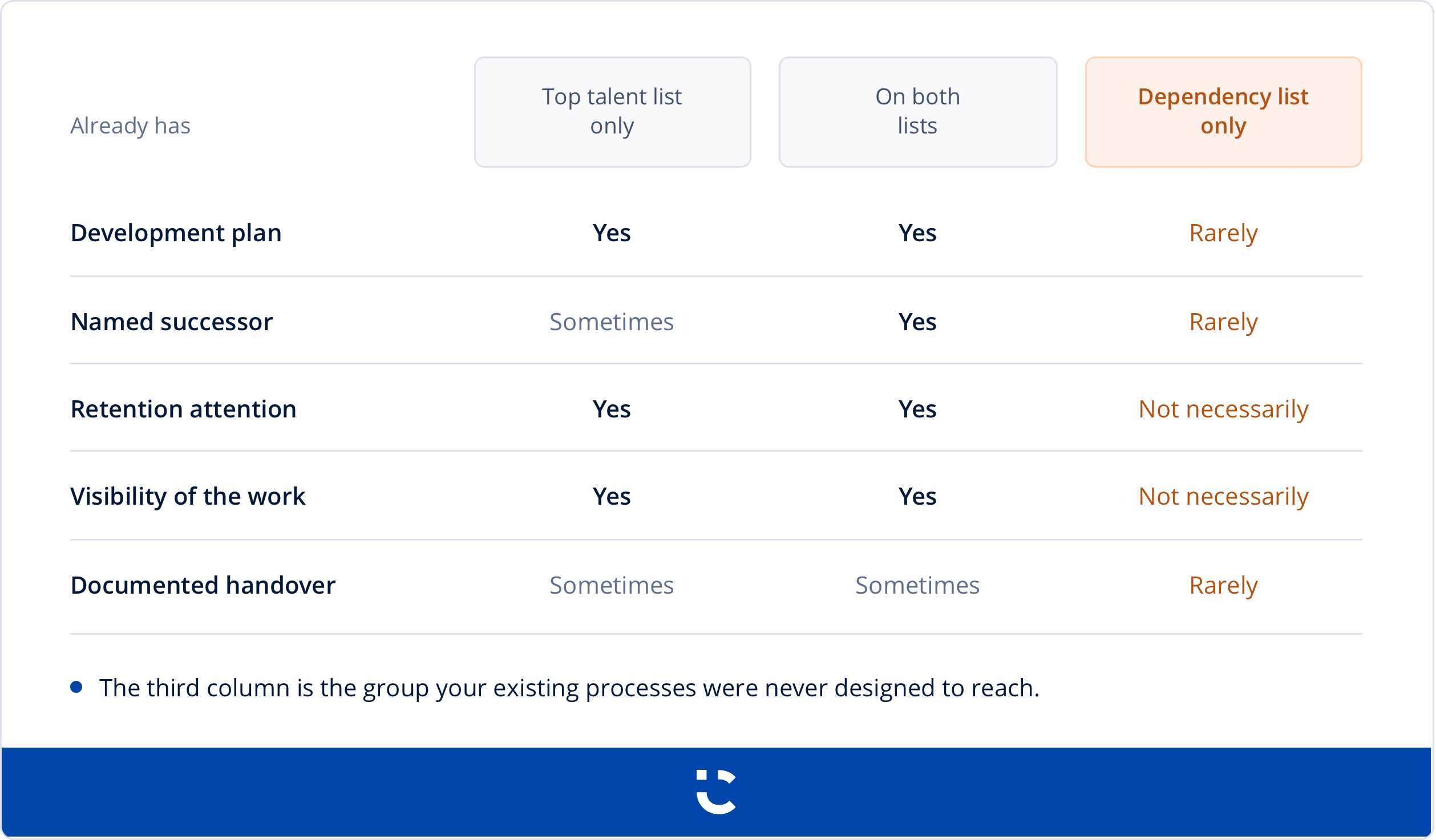
The two are also not the same list, and the gap is wider than expected. There’s a quick way to check it against your own organization. Take last year’s top talent slate. Then ask four or five team leads which people on their team would be genuinely hard to cover for a month, and compare.
The names that appear on the second list and not the first are the interesting part. Everyone else has some process pointed at them, whether it’s a development plan, a successor, or visibility. This group has none of it.
Why the two lists pull apart
Talent ratings measure how well someone does their job and how much bigger a job they could do. Key-person dependency measures how many other people could do that job if the person doing it stopped. There are a few factors that push them apart.
Visibility is one. Work that happens where others can see it is easier to hand over, because someone else has watched it done. Work that happens out of view has no such backup, and sometimes it’s also the reliability of how it’s done that keeps the work in the shadows. Think of a payroll admin who has closed the monthly cycle without incident for eleven years and therefore never produced a reason for anyone to examine the process.
Then there is the structure. A manager carrying a very large team has little realistic room to develop a second for anyone in it. Layered reporting lines route decisions and approvals through a small number of people who become bottlenecks by design rather than by accident.
The third is that talent ratings look for range, and dependency comes from depth. High potential means someone could likely do a bigger job next, so it rewards breadth. What makes a person hard to replace is years of specific knowledge about one thing.
Key-person dependency vs succession planning
Succession planning and key-person dependency risk often get folded together, but there is a key distinction to remember. Succession planning asks who could take over a role in the future. Key-person dependency asks what would stop next Monday.
The two produce different names because succession planning follows the roles that matter for future continuity, and key-person dependency follows wherever critical knowledge, access, and relationships are concentrated today.
For example, the production scheduler who knows which supplier will accept a late change or which machines run slower than the specification says. None of this is typically written down, none of it appears in a succession review, and the production plan won’t hold without it.
What the data will and won’t tell you
Whether a role is critical is down to judgement about the business rather than a field in your HRIS records. Data, however, does help you narrow down the search.
There are a few useful clues about where to look first:
- Roles currently held by a single person
- Teams with no named deputy
- Managers with spans wide enough that development conversations aren’t realistically happening
- Layers where approvals concentrate in few hands
- Specialists with no adjacent skill coverage nearby
None of this proves a key-person dependency exists. Spans and layers won’t tell you the business, or one part of it, would stop. They do tell you which teams to ask first.
Where Crunchr fits
Criticality is something you set on the role, independently of how the person in that role is performing. This separation is the key guiding point: the roles a business can least afford to lose and the people it notices are not the same list.
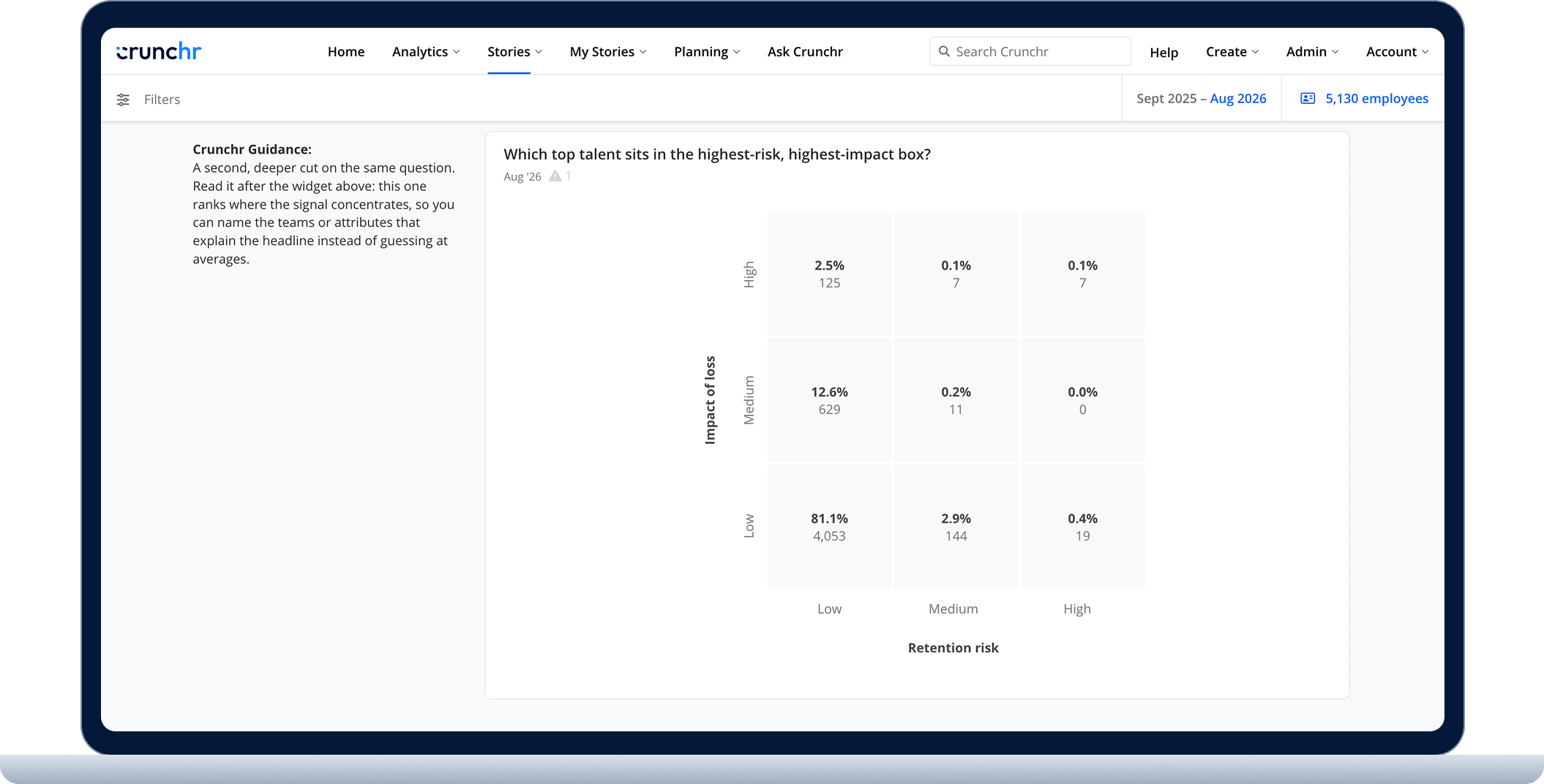
Successor coverage is visible per department rather than only for senior positions, which is where succession planning tends to stop looking and where dependency tends to start.
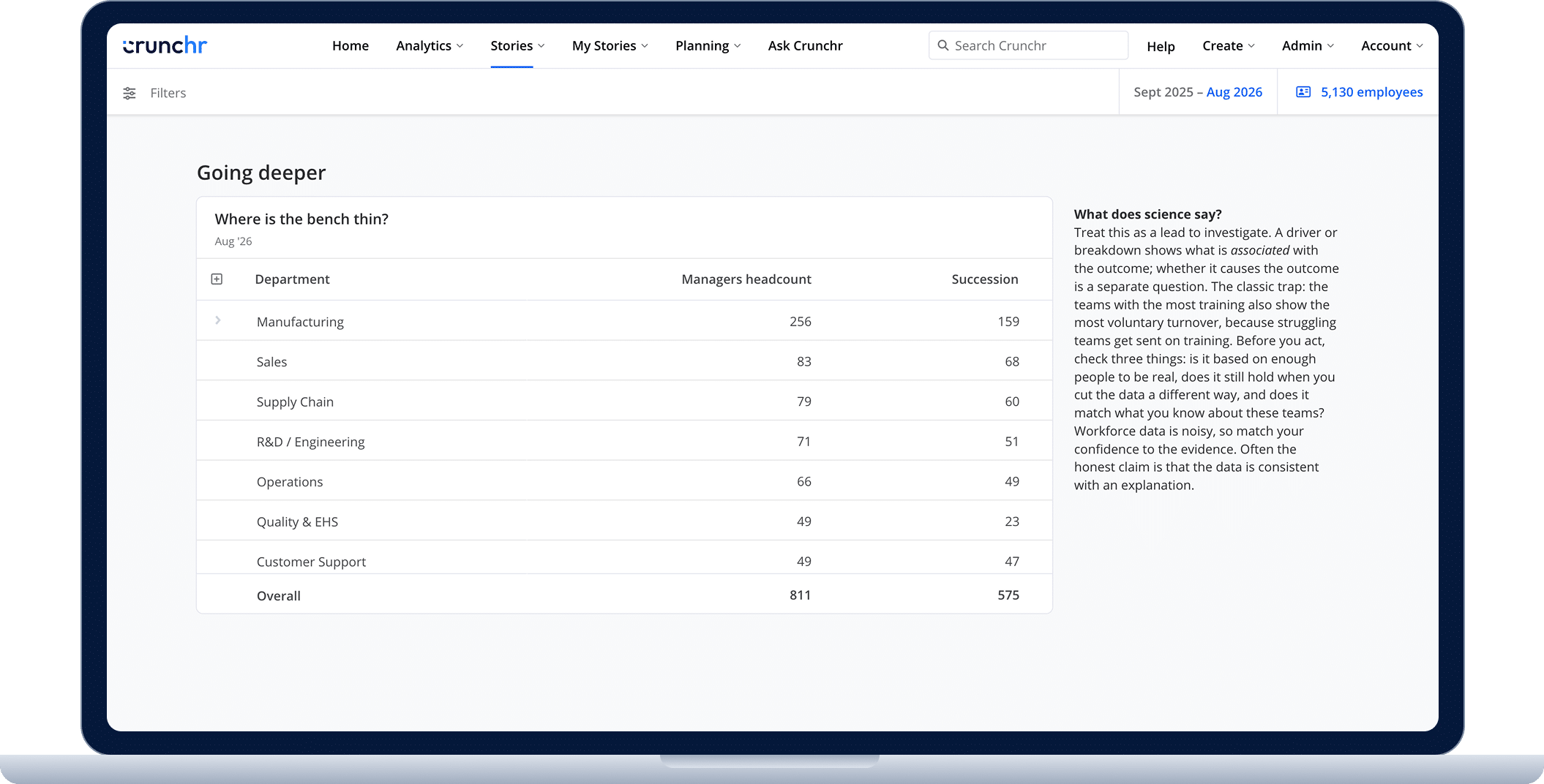
Take an example where a manufacturing department has fewer than one backup per manager, giving it thinner coverage than other functions in the organization.
Put another way: if three of those managers resign in the same quarter, there’s a real risk that one or more of those seats has no ready successor.
Other functions in the same company have more than one successor per manager. That is to say, the shortfall isn’t always a company-wide policy failure. It can be concentrated in one place, and it takes a departmental view to see it.
Spans and layers sit alongside both, showing where structure concentrates decisions.
One thing to remember: somebody still has to decide which roles are critical and mark them as such. No platform infers that for you. Workforce analytics tools remove the manual assembly, but the judgment stays yours.
One question, starting this week
You don’t need a project for this, you need one question.
- Ask each team lead which processes, systems, client relationships, and approvals are handled by only one person on the team.
- Collect the answers in one place. A shared document is enough. The value is in aggregation.
- Look for names appearing more than once. A name that surfaces across two teams is a stronger signal than anything a manager will tell you about their own area.
- Compare the list to your succession plan. The part that doesn’t overlap is your actual exposure.
The fix is smaller than the risk
Key-person dependency concentrated in a small, named group of people can be addressed with a small, named set of actions.
- Name a backup and tell everyone involved.
- Document the knowledge stored in private files or someone’s mind, particularly the process that has never failed and therefore never got documented.
- Share access. Credentials and approval rights held by one person are the easiest dependency to fix and most commonly missed.
- Have the retention conversation, to try and lower the probability that the person leaves.
Set against a company-wide continuity program, this is inexpensive. Finding where to apply is the hard part. The names are easiest to collect while the delays are still fresh. By January, the same question gets asked in a planning session, and answered from memory, which produces a different and poorer list.
FAQ
The exposure a business carries when specific work can only be done by specific people. It’s a human single point of failure: how many people could pick up the work if the person carrying it stopped, and how long they’d take to catch up.
Succession planning asks who could take over a role in the future. Key-person dependency asks what would stop next Monday. They produce different names.
Talent ratings reward breadth: how much bigger a job someone could do. Dependency comes from depth, years of specific knowledge about one thing.
Ask each team lead which processes, systems, client relationships, and approvals are handled by only one person. Collect the answers in one place and look for names that appear more than once. Compare that list to your succession plan; the part that doesn’t overlap is your exposure.
Name a backup and tell everyone. Document what lives in one person’s head. Share credentials and approval rights. Have the retention conversation.
 Share on X
 Share on Facebook