

Implementation story
From Data Stored to Data Seen
We did see patterns, but we couldn’t bring them to life, couldn’t make them visual, couldn’t pinpoint them.”

Tara Smits-KoelemanHRIS Analyst at Cosun
How a 4,700-employee Dutch food and agriculture cooperative moved from manual workforce reporting to an interactive people analytics platform in less than four weeks.
Cosun has been turning plants into food for 125 years. What started as a sugar beet cooperative in the Netherlands has grown into an international group working across five business lines, producing everything from plant-based proteins to dietary fibers and green energy. Over 8,000 growers are members of the cooperative, and around 4,700 people work across its companies every day.
To understand how the company tackled workforce visibility, we spoke with Tara Smits-Koeleman, HRIS Analyst, Ingrid van Ommen, HRIS Manager, and Arjan Spies, TA Manager.
The challenge
Data in the system, insight out of reach
We did see patterns, but we couldn’t bring them to life, couldn’t make them visual, couldn’t pinpoint them.”
Tara Smits-KoelemanHRIS Analyst at Cosun
Four years ago, Cosun made a significant investment in HR infrastructure—unifying all five business groups onto a single Workday tenant for the first time. The data was there, centralized and structured. Using it was a different challenge altogether.
Workday’s reporting capabilities were powerful, but came with a steep learning curve. Extracting meaningful figures required specialist knowledge—there was no way for someone without deep system familiarity to build their own reports or dashboards. Combining metrics across dimensions meant days in Excel. Basic workforce questions—headcount, FTE, turnover—couldn’t be answered on demand.
A request for reporting-layer insight across the organisation could take a full day to assemble. While the underlying data existed, the way it was surfaced did not provide the kind of integrated, decision-ready insight leadership needed.
We can get all the data out of Workday, but to make it visual, easy, accessible—that was really difficult.
The team could see patterns within individual datasets. What they couldn’t do was surface them at the group level, connect them across dimensions, or shape them into something that told a coherent story to leadership. At that scale, such a gap had real consequences.
Why Crunchr, and why now
The question of workforce visibility had been building for a while.
When Arjan joined Cosun, it quickly became clear that although Workday held the data, answering even basic workforce questions on demand still required significant manual effort. In a complex, multi-entity organisation, extracting cross-dimensional insight remained slow and specialist-driven.
Building an internal dashboarding solution was also considered, but the reality of maintaining a manual reporting layer gave the team pause.
Although building a manual dashboard gives the team full control, it also comes with real risks.
You can set up an extensive overview, but if someone adjusts something in the underlying data or structure, the whole thing can fall apart. And it’s not always immediately obvious. Sometimes it takes days before anyone notices something is off, let alone gets it fixed.
What accelerated the decision was a specific business moment. In March 2025, Cosun was working through a period of organizational change and needed to model workforce scenarios quickly—understanding what different outcomes would mean for the shape of the organization. Without a platform that could connect and visualize that data, the team would be in the dark at exactly the moment they needed clarity.
Two platforms were evaluated, each addressing a different part of the workforce data challenge. Given where Cosun was on its growth path, the team concluded that getting workforce visibility right was the natural first step. So, they decided on setting a solid analytical foundation before layering in additional capabilities.
For Ingrid van Ommen, Cosun’s HRIS Manager, who had evaluated tooling options across the organization, the conclusion was straightforward:
Crunchr is the easiest, most user-friendly, practical tool.
Four weeks
How the implementation came together
The contract was signed at the end of November 2025 and the first kick-off meeting held in early December. Data was ingested before Christmas. The first analytical stories were built in early January 2026.
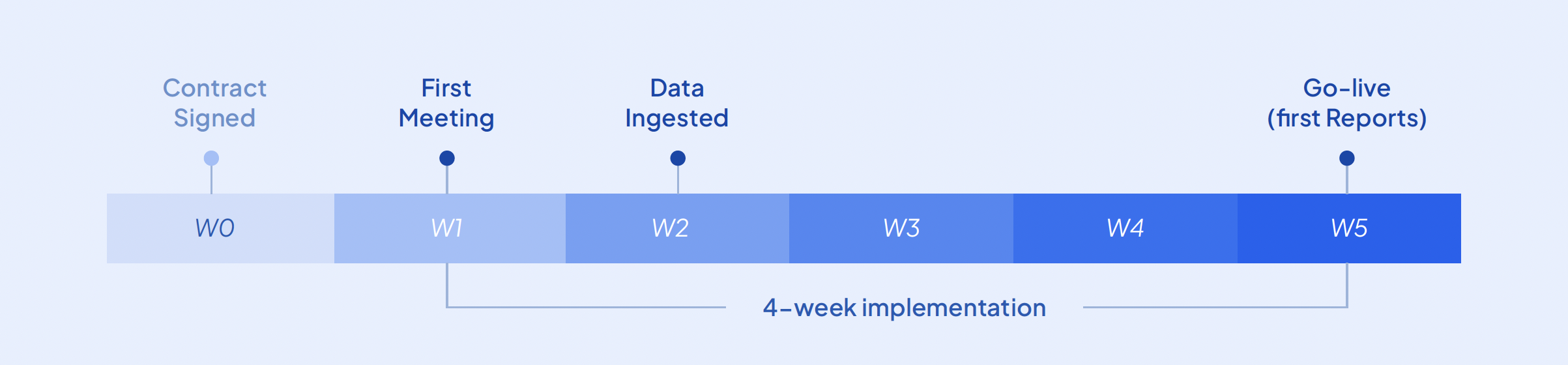
That timeline wasn’t left to chance. The team had a firm internal deadline: go live before the end of the year, with a formal internal presentation to HR Directors scheduled for the first week of January, leaving less than four weeks to get from kickoff to a working platform. And they made it—thanks to three things.
The first was ownership. Tara dedicated two to three days a week to the implementation. She knew the data, had direct access to it, and could make decisions without escalating. Her colleague Stijn, supporting the HRIS side, was available to step in when needed. Ingrid and Arjan were on standby for testing and input. It was a small group, with clear accountability and ownership and direct access to the data.
The second was integration. Cosun’s native Workday RAAS connection meant only one report needed to be prepared on their side—after that, the Crunchr team pulled the data directly. Tara built the Workday report herself, regardless.
I wanted to do it myself—to understand which data we are bringing to Crunchr and why.
The third was the daily rhythm. Check-in calls between the Cosun and Crunchr teams ran throughout the implementation, keeping decisions from stacking up and questions from going unanswered.
We were really taken by the hands in this implementation. From my point of view, the Crunchr team was always available and always helpful—to change anything or answer our questions.
Tara Smits-KoelemanHRIS Analyst, Cosun
From the Crunchr side, the experience was equally clear-cut. It wasn’t just the Cosun team’s preparedness that impressed.
Cosun brought great energy from day one. Within just a few days after the initial data model discussion, we had their first data on Crunchr, and within a week, we had the Workday RaaS connection up and running. Their preparation and clear view on the key data points meant that we could focus on data quality and quickly validate the right insights for the go-live.

Nayana AjoyData Engineer, Crunchr
The Cosun team was a great pleasure to work with. They were focused, curious, engaged and always with a laugh or a smile. It showed in how quickly they got up and running.

Marieke JesseVP Customer Success, Crunchr
What the data revealed
The shift was immediate. Questions that had previously required a full day of extraction and manual assembly could now be answered in hours. Reporting layers and FTE counts across multiple dimensions, spans, and layers—all became available on demand, without a specialist, without Excel.
It was really amazing to see that it was so easy to just filter data, change data, actually create a report yourself, and combine it all. It would take years to create something like this in Workday
But the more significant shift was in what the data started surfacing unprompted. During the talent review with HR leadership, the team identified a cluster of employees aged 65 and above—high-flight risk, high impact of loss. Retirement was approaching for a group of people the organization couldn’t afford to lose quietly. This insight had always been somewhere in the data. Now, for the first time, it was visible.
What comes next
Cosun’s people analytics journey is, in Tara’s own words, only just beginning. The January go-live was a starting point—a working platform, an initial dataset, and a first set of HR directors who could see their workforce in a way they hadn’t been able to before. The reactions were positive and the appetite for more was immediate.
The evaluation session in February turned that appetite into a plan.
For the first half of the year, the focus is on dashboards: a KPI dashboard, a CSRD dashboard, and by year-end, an equal pay transparency dashboard. Each one represents a reporting need that currently sits in Power BI or Excel—and that Crunchr is expected to absorb.
Adoption is another priority. Tara’s goal is straightforward: when someone at Cosun needs workforce data, Crunchr should be the first place they go.
I really want people to use it. When they need data, they will think—let’s go to Crunchr.
Beyond dashboards, the data scope is set to grow. Peakon engagement data and recruitment system data are both on the roadmap, which will allow the team to connect workforce composition, employee sentiment, and hiring patterns into a single view for the first time.
The longer-term ambition is a shift from reactive to predictive. Right now, the team is looking into what happened, explaining patterns after the fact. The next phase is anticipating what’s coming.
Maybe we can just predict some aspects and trends with the data we have. That will be the next phase.
For Cosun, the go-live didn’t just change how the team accessed data. It changed what they could see and what they could no longer set aside. The retirement risk was always in the data, but asked for the right lens to surface it. And once you can see it, you can’t unsee it.
Wondering what’s hiding in your workforce data?
We’re happy to take a look together.
Explore how teams like Cosun approach implementation, onboarding, and early adoption—and see whether Crunchr fits your people analytics setup.


